A full workshop doesn’t always mean a profitable workshop.
You’ve got cars on hoists, mechanics working flat out, phones ringing and customers waiting for estimates. Everyone’s busy, but at the end of the month, the profit doesn’t always reflect how hard everyone has worked.
Sound familiar?
The problem often isn’t how much work you’re getting. It’s how much time you’re losing getting that work done.
Where does all the time go?
Think about what happens during a typical workshop day.
- A mechanic stops working to answer a question or look up information.
- Someone spends 15 to 60 minutes putting together an estimate.
- A customer phones wanting an update on their car.
- The service adviser searches through job notes to find an answer.
- A technician waits for approval before continuing repairs.
- Someone has to remember to follow up with customers who haven’t approved their estimates.
Each interruption might seem small, but they quickly add up.
Your mechanics might be busy for eight hours, but how many of those hours are actually productive?
Just 15 minutes a day can cost thousands
Let’s say you have four mechanics, each losing just 15 minutes a day to interruptions and unnecessary administration.
That’s one hour of workshop time every day.
At a labour rate of $120 per hour, that’s potentially:
| Period | Lost labour capacity |
|---|---|
| Daily | $120 |
| Weekly (5 days) | $600 |
| Yearly (48 weeks) | $28,800 |
That’s nearly $29,000 worth of potential labour capacity every year, without accounting for the time your office staff spend on similar tasks.
Of course, not every minute saved will turn into additional revenue. But if you have more work waiting, reducing wasted time can make a real difference.
What if everything just happened faster?
Imagine preparing an accurate, profitable estimate in minutes instead of spending up to an hour manually calculating labour, entering information and checking pricing.
Imagine customer information, vehicle history, repair orders, invoices and estimates all being connected, so your staff aren’t constantly switching between systems or trying to remember what’s been said.
Imagine reminders and follow-ups happening automatically instead of relying on someone to remember them.
Less searching. Less typing. Less waiting. More work getting done.
That’s where AI workshop software can make a real difference.
Imagine simply talking to your workshop software
What if, instead of searching through screens and records, you could just ask your workshop software to do something?
You could speak naturally to the AI in real time, just as you would to another member of your team.
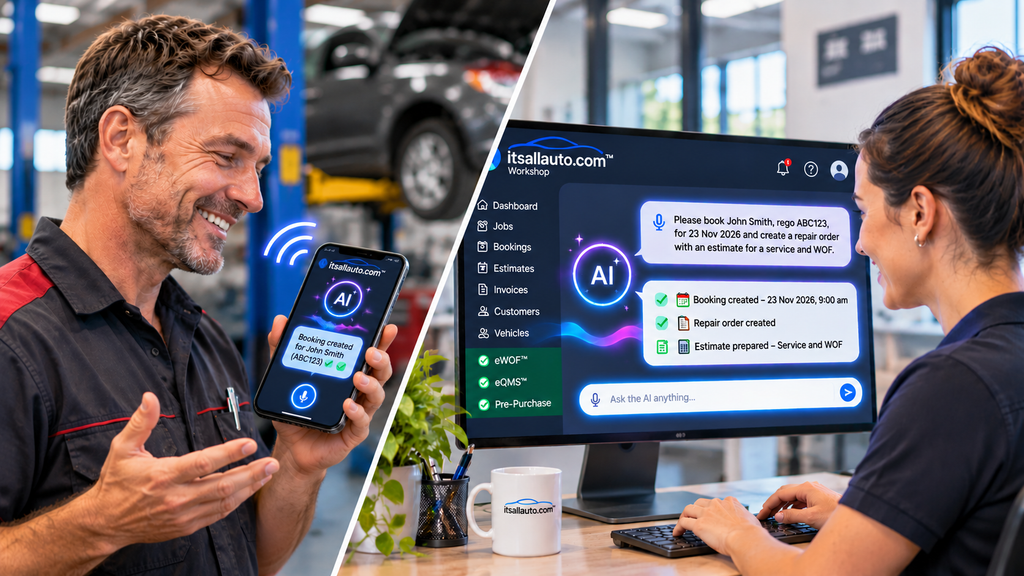
For example, imagine an existing customer phones to book their car in. You simply say:
“Please book John Smith, registration ABC123, in for 23 November 2026, and create the repair order including an estimate for a service and WoF.”
The AI could identify the existing customer and vehicle, check the diary, create the booking, prepare the repair order and generate the estimate using your workshop’s pricing.
All from one simple instruction.
You could also ask things like:
- “What’s happening with the Toyota Corolla?”
- “Has the customer approved the repairs on the Mazda?”
- “What did we tell the customer about their transmission problem?”
- “Which estimates are still waiting for approval?”
- “What jobs do we need to follow up today?”
The AI can give you the answer immediately, either speaking the answer back to you or displaying it on screen.
And because it’s conversational, you can ask follow-up questions or give another instruction without starting again.
More repairs approved while the vehicle is still on the hoist
Speed matters.
When estimates are prepared faster, customers can receive them sooner.
Better still, a customer could receive and approve an estimate while their vehicle is still on the hoist, allowing the additional repairs to be completed there and then instead of rebooking the vehicle for another day.
That means:
- fewer return visits
- less wasted workshop time
- less administration
- faster turnaround
- a better experience for the customer
Imagine taking a day off without the workshop constantly calling you
One of the biggest frustrations in a busy workshop is when important information is stuck in someone’s head.
Perhaps the owner knows what was agreed with a customer, the service adviser knows which repairs have been approved, or a mechanic remembers something important that hasn’t been written down.
But what happens when that person is away?
Imagine a system where everyone has simple access to the information they need to keep the workshop moving.
Customer communications, job progress, estimates, approvals, repair orders and notes are all connected and easy for authorised staff to access.
And instead of hunting through records, they can simply ask the AI and get an answer in seconds.
The workshop keeps moving, customers get answers and the business becomes less dependent on one person.
What could AI workshop software help with?
Think about how much faster and easier a typical day could be:
- Faster bookings — create bookings, repair orders and estimates with less manual work.
- Faster estimates — prepare estimates more quickly and get approvals sooner.
- Instant answers — talk to the AI and receive spoken or written responses.
- Invoice generation — generate invoices faster with less repetitive admin.
- Automatic reminders and follow-ups — reduce missed bookings and missed opportunities.
- More same-day repairs — get estimates approved while vehicles are still on the hoist.
- Less reliance on one person — the team can access the information they need.
- Connected systems — link workshop management with eWOF™, eQMS™ and Pre-Purchase Checks.
What we’re doing at Grimmer Motors in Hamilton
At itsallauto.com, we’re developing and testing AI-powered workshop software in our own busy automotive workshop, Grimmer Motors in Hamilton.
We’re mechanics ourselves, so we understand the everyday pressure of running a workshop.
We’re already using AI technology at Grimmer Motors to help with tasks such as preparing estimates, retrieving information, generating invoices, organising customer communications and reducing repetitive administration.
One of the most exciting opportunities is being able to talk to the AI in real time, ask it questions or instruct it to carry out workshop tasks, and receive the answers either spoken back or displayed on screen.
We’re also working towards a connected system that integrates with eWOF™, eQMS™ and Pre-Purchase Checks, while also helping automate reminders and follow-ups.
We’re developing this technology into a workshop management system that we plan to make available to other New Zealand garages in 2027.
We’ll share more about what we’re learning and developing over the coming months.
Because making more money in a workshop isn’t always about getting more vehicles through the door. Sometimes it’s about getting the work done faster, with less admin and less delay.
I’m generating the image now.