Electronic Quality Management System (eQMS™) is now included at no extra cost with your eWOF™ system if you do over 40 WOFs per month.
Watch our short video to see how eQMS™ works inside eWOF™ and makes everyday QMS WOF compliance easier:
Jeremy – Auto Services Newmarket
“The eQMS is brilliant. I can’t fault it at this stage.
The biggest benefit is that it actively prompts us to keep working on our QMS. It highlights missing documents, pending updates, inspector records and things like equipment calibration or testing requirements. With a paper system, it’s easy to put the folder away and forget about it for 12 or 18 months. The electronic system keeps everything front of mind.
It’s no different from sending a customer a service reminder. People often won’t act unless they’re prompted, and the eQMS does that automatically. I could put all those reminders into my phone, but why would I when there’s a system that does it for me?
It has also helped identify records that needed attention, including an inspector transfer that was recorded on paper but hadn’t yet been added electronically. Pending-document alerts make you check the system and complete what’s required, rather than relying on memory or manually flicking through a folder.
The support has been really good as well. I know I can rely on the team, and when an issue comes up, it gets resolved promptly. Overall, it’s easy to use, keeps us organised and gives us much better visibility of what needs to be done.”
Shane – Kerikeri Diesel – Kerikeri
“Overall, the electronic QMS is brilliant. I’ve found it quite easy to use, especially for recording conflicts of interest, complaints and staff training. When we complete training, it automatically goes into the QMS, so I can demonstrate that my team and I have done what was required without having to manually write everything up.
It took a few uses to become familiar with the system, but once I got used to it, I found it very helpful. It guides you through the process, keeps an electronic record of everything and makes managing compliance much easier.
I’m over 60, and I’ve found it bloody convenient. For anyone thinking they’re too old for this technology nonsense, it’s a whole lot easier than writing everything down.
It saves time, the records are easy to access, and no one has to read my handwriting. I just can’t see why you wouldn’t use it. I think itsallauto has done a pretty nice job.”
Richard – Riversdale Service Station – Riversdale Southland
“The eQMS puts everything in one place, and the prompts are awesome. It’s much easier than flicking through a folder trying to find records, and I think it will be invaluable when it comes time to complete self-audits.
Even from the little I’ve used it so far, it has already picked up that our new inspector needed to complete training. Having those reminders and requirements automatically brought to your attention means things are less likely to be overlooked or left until an NZTA inspector is due to visit.
The QMS is a vital part of our business, and we like to do everything by the book. Having a system that helps us keep our records organised and stay on top of our responsibilities is something I really value.
I’m certainly not a computer-savvy guy, but the system is simple to use. If I can do it, anybody can. I’ll definitely be using it.”
Brett – Wills Autoworks – Whakatane
“The eQMS is very easy to use. I’m not a particularly techy person, but most of it only took me a couple of seconds to figure out.
The warrant sticker and controlled-document records are especially straightforward. I number every warrant sticker book, and I can record the book number, comments and completion date all in one place. I’ve also started adding our equipment as each item comes up for renewal.
The automated reminders will be bloody good. I’ve been caught out before when things like axle stands or jacks were due to be checked, so having a notification telling me what needs attention will make it much easier to stay on top of everything.
I’ve been running the eQMS alongside my existing folder while I set it up, and everything I’ve used so far has worked as I expected. It’s simple, practical and will make managing our records and equipment requirements much easier.”
Craig – Green Bay Auto Services – Auckland
“From what I’ve seen so far, I quite like it. It’s all laid out nicely, with equipment, documents, performance and assessments, so everything is easy enough to find and it’s all there.
I like that I can get everything in one place, and the training is good too. It creates the training record automatically, and because it’s available on my phone, I can complete it whenever I have time.
It’s easy enough to get into, and everything I’ve seen so far sounds bloody good to me.”
How eWOF™, Training, ePRS™ and eQMS™ Work Together
For many New Zealand workshops, the hardest part of compliance is not doing the inspection itself. It is keeping QMS records complete, keeping staff current with VIRM amendments, and making sure everything is easy to prove when NZTA audits the site.
That is where connected systems make a real difference.
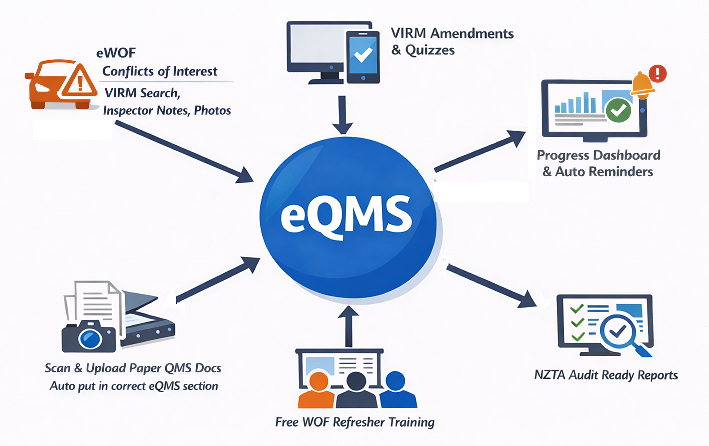
When eWOF™, WOF refresher training, electronic PRS (ePRS™), and eQMS™ work together, compliance becomes easier to manage because the records are built as part of normal workshop activity. Instead of relying on paper files, memory, or disconnected admin tasks, workshops can follow a more guided process that is easier to maintain and easier to explain during an audit.
** eQMS™ is included with your eWOF™ system at no extra cost when you complete at least 40 per month. If you don’t do 40 per month, then the cost is $39.95 per month. **
Why this matters
Many workshops know the technical side of inspections well, but compliance can still become difficult when records, updates and training are managed separately. A workshop may be doing good work day to day, but still struggle to show complete records, clear staff training history, or evidence that VIRM changes have been kept up with.
That is why the real value is not just in having digital tools. It is in having them connected.
A simpler way to think about compliance
A connected compliance workflow can be understood in four parts:
eWOF™ is where inspections are carried out, automatic VIRM searches, Conflicts of Interest, Inspector Notes on a WOF, and Photos as WOF evidence will all be integrated with your eQMS™.
Training is where inspectors stay current and refresh their knowledge – every 2 months.
eQMS™ is where the records and audit trail are kept, and automatically linked to your eWOF™ inspections
ePRS™ is where we simulate your current Performance Review Score for early warnings!
When these parts work together, the workshop does not need to keep rebuilding the compliance picture from different places. The system helps create that picture as the work is done.
What this looks like in practice
A workshop carrying out inspections in eWOF™ also needs to keep up with WOF refresher training, VIRM amendments, ePRS™ scores, and QMS recordkeeping. When those tasks are managed separately, it usually means more paperwork, more double-handling, and more risk that something gets missed.
When the systems are connected, the process becomes much simpler:
- Inspections are completed in eWOF™
- WOF refresher training supports inspector knowledge
- VIRM amendment activity can be recorded as part of the same wider system
- eQMS™ records are easier to keep complete and current
- ePRS™ gives you real-time early warnings if you need to improve your systems
- NZTA audit evidence is easier to find when it is needed
This helps reduce duplication and gives workshops a clearer compliance trail.
Repeated non-compliance can waste time and cost money
Non-compliance is not just frustrating. It can become time-consuming and expensive.
The Auditor-Generals report says lower-level non-compliance can lead to follow-up action, including letters and sometimes a revisit within two to four weeks. The report also notes that non-compliance creates extra workload because NZTA has to carry out further site reviews.
There are cost risks as well. NZTA may charge $160 per hour plus GST for monitoring and review where there is evidence of serious or repeated failures to comply. The Auditor-General also says NZTA began issuing $370 infringement fees for non-compliance in 2024.
That means repeated compliance problems are not just a paperwork hassle. They can lead to extra visits, extra stress, and official costs.
Sending your paper-based QMS away can cost hundreds and still leave you exposed
Some workshops still send their paper-based QMS away to a WOF consultant to get filled in for them. That can easily cost hundreds of dollars, and you may still end up with paperwork your team does not properly understand.
That is a risk if NZTA asks questions during an audit. They are not just checking whether a folder exists. They may want to know what was done, why it was done, and how your workshop follows those processes in day-to-day practice. If your QMS has simply been completed externally and handed back, that can leave your team exposed.
A guided eQMS™ is a better option because it helps your workshop build, maintain, and understand its own QMS as part of normal operations.
Why WOF Refresher Training matters
WOF Refresher training is not just a bonus. It supports consistency, helps inspectors stay current, and reinforces correct inspection practice over time. That matters for experienced inspectors as much as newer ones, because requirements change and habits can drift.
Training becomes even more useful when the records are not sitting separately from the rest of the workshop’s QMS compliance system. When training activity forms part of the overall eQMS™ compliance record, it becomes easier to show that staff knowledge is being maintained as part of normal operations.
Why eQMS™ adds value
A paper-based QMS can become hard to manage. Documents can go missing, records can become outdated, and staff can be left unsure about what should be filed, what some of the questions mean, and where it belongs.
A guided eQMS™ helps by keeping records more structured and visible. If information is missing, it is easier to spot. If older paper records need to be kept, they can be scanned or photographed, and your eQMS™ system automatically adds them into the right place, rather than being left in separate folders or drawers. For example, if you take a photo of your hoist service invoice in the eQMS™ system, it will automatically put it into the equipment records section of the eQMS™.
That makes the eQMS™ not only easier to maintain but also easier to understand.
ePRS™ coming soon…!
NZTA PRS (Performance Review System) measures the quality and consistency of WoF inspections to determine if inspectors are operating safely and correctly. We are creating an electronic Performance Review System (ePRS™) so that you can get a better understanding and indication of what your likely NZTA PRS score will be.
What is the difference between eQMS™ and ePRS™?
QMS is your internal system and processes, while PRS is NZTA’s evaluation of how well those processes are followed in real inspections.
Moving from paper does not have to be all or nothing
Workshops do not have to convert everything at once.
A practical approach is to keep accurate records from the last NZTA audit up to the date of change, then maintain records digitally from that point onward. If older paper-based documents also need to be included, scanning or photographing them into the eQMS™ can help bring them into one organised system.
This makes the transition more manageable and avoids turning conversion into a bigger job than it needs to be.
Less chasing, less duplication, better audit readiness
The biggest benefit of integration is not just that each tool is useful on its own. It is that the workshop spends less time chasing paperwork and trying to prove things after the fact.
When inspections, training activity and QMS records are tied together, workshops are in a stronger position to:
- keep records more complete and current
- support staff with ongoing refresher learning
- reduce gaps caused by manual processes
- build a clearer audit trail
- make NZTA audit preparation less stressful
That is a much simpler model than treating compliance as a separate admin task after the work has already been done.
Conclusion
The challenge for many workshops is not understanding how to inspect a vehicle. It is keeping records, training, and compliance evidence organised well enough to stand up during an audit.
That is why eWOF™, WOF Refresher Training, eQMS™, and ePRS™ work better when they are connected.
Instead of managing inspections, staff knowledge, and QMS documentation separately, workshops can use one workflow that helps create the compliance record as the work is done. The result is a simpler system, a clearer audit trail, and a more confident approach to NZTA compliance.
** eQMS™ is included with your eWOF™ system at no extra cost when you complete at least 40 per month. If you don’t do 40 per month, then the cost is $39.95 per month. **
P.S. We highly value your feedback, so once you start using the eQMS™ system, please let us know your ideas, thoughts, and issues, and we will regularly update the system to improve it!